Dec, 10, 2025
PhotographySpecial Engagement ExhibitionsMedia AlertsPhotography
First solo museum exhibition of contemporary Chemehuevi/ American artist Cara Romero to be presented at Phoenix Art Museum
Opening February 2026, Cara Romero: Panûpünüwügai (Living Light) at PhxArt includes debut of new commission created by Cara Romero—a project based in regional, collaborative storytelling with Native peoples
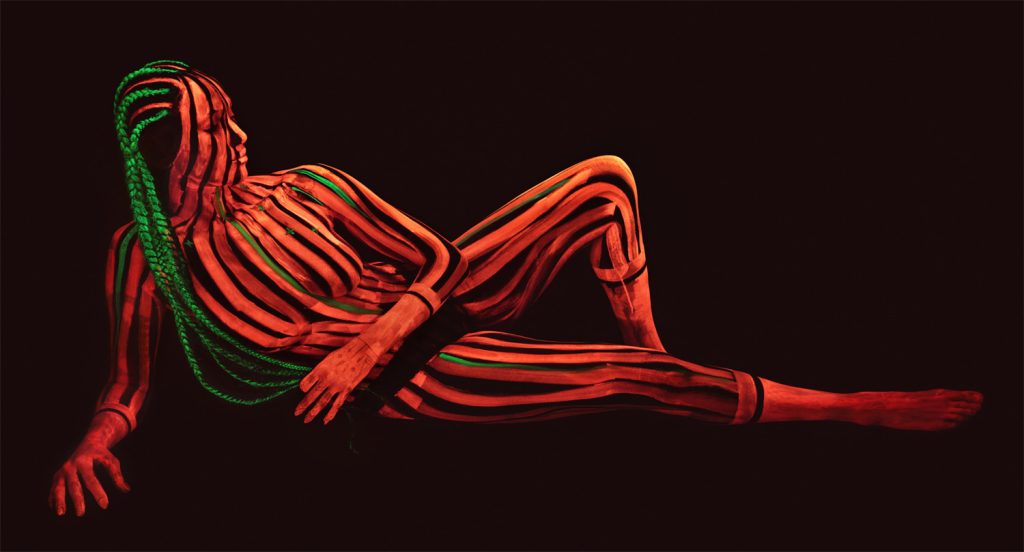
Cara Romero, Alika No. 2, 2024, archival pigment print. © Cara Romero. Image courtesy of the artist.
PHOENIX, AZ (December 9, 2025) – In early 2026, Phoenix Art Museum (PhxArt) will present the landmark exhibition Cara Romero: Panûpünüwügai (Living Light), the first major museum exhibition dedicated solely to the artist’s evocative work. Romero blends fine art and editorial styles to challenge dominant narratives of Indigenous decline and erasure while disrupting preconceived notions about what it means to be a Native American. Organized by the Hood Museum of Art, Dartmouth, Panûpünüwügai (Living Light) features more than 60 iconic large-scale photographs spanning a decade of the artist’s career, including a new, never-before-exhibited work commissioned by PhxArt to be created by Cara Romero—a project based in regional, collaborative storytelling with Native peoples. Cara Romero: Panûpünüwügai (Living Light) will be on view at PhxArt from February 28 through June 28, 2026.
“Phoenix Art Museum is profoundly honored to debut Cara Romero: Panûpünüwügai (Living Light) during this historic moment for the institution, as we expand our commitment to presenting the most innovative voices shaping contemporary art today,” said Jeremy Mikolajczak, the Museum’s Sybil Harrington Director and CEO. “Romero stands at the forefront of contemporary photography, masterfully weaving materials, myths, and Indigenous practices with urgent contemporary realities. Though rooted in her personal story and Indigenous futurism, her work speaks universally to themes of women’s empowerment, environmental stewardship, and the role of landscape in shaping identity. This exhibition represents a milestone for our communities to experience the work of a groundbreaking artist with deep cultural and historical ties to the Desert Southwest.”
Cara Romero (b. 1977; Chemehuevi/American) is a renowned photographer known for dramatic fine-art photography that examines Indigenous life in contemporary contexts. An enrolled citizen of the Chemehuevi Indian Tribe, Romero was raised between the contrasting settings of the rural Chemehuevi reservation in Mojave Desert, California, and the urban sprawl of Houston, Texas. Informed by her identity, Romero’s visual storytelling represents Indigenous and non-Indigenous cultural memory, countering dominant narratives of Native American experiences and showcasing the diversity within Indigenous nations and communities.
“Having a contemporary photography exhibit at Phoenix Art Museum marks a radical turn in my journey as a Native American female photographer,” said Cara Romeo. “I am excited for the work to be integrated into an American Art museum as an intercultural conversation– I’m especially excited that PhxArt is the closest major American Art institution to my homelands on the Chemehuevi Valley Indian Reservation.
This is my first solo exhibition touring the United States, and Phoenix is the second of four venues. It feels like such an epic venue for this exhibition. My hope is that together, we open people’s minds to the many fascinating diversities of Native people and stories.”
The exhibition’s title, Panûpünüwügai, translates to “living light,” and has multiple meanings: the spirit of light, the way light interacts with human beings, and how both light and people are enlivened through these interactions. Featured works, including site-specific installations and large-scale photographs, are organized across five thematic sections:
California Desert and Mythos draws inspiration from Romero’s experiences of growing up in the Chemehuevi Valley in Southeastern California along the Colorado River, which shaped her worldview and work. Throughout this section, visitors encounter four young boys who represent not only themselves, but also time-traveling spirit beings of the landscape, reminding audiences that neither time nor the rich ecological and social history of the Mojave Desert are linear.
In (Re)Imagining Americana Drawing, Romero upends stereotypical images and stories from pop culture and mass media that often define Native-American experiences and opportunities. Working with various collaborators to produce the works featured in this section, Romero riffs on images of American Girl dolls and Leonardo da Vinci’s The Last Supper, among other mainstream imagery.
Rematriation: Empowering Indigenous Women showcases images that position female subjects in spaces of power. Created from a maternal and biographical perspective, these works are informed by the women leaders Romero has encountered in her own life and community.
Environmental Racism spotlights some of Romero’s most memorable images, speaking to historical and contemporary issues of resource extraction and its impacts on indigenous ecosystems. These photographic dreamscapes—many of which were created underwater—encourage reflection on the relationships among humanity, place, the landscape, and extractive economies.
Throughout Ancestral Futures, Romero’s otherworldly images speculate on playful contexts but assert the sacred role of ancestral knowledges and place-based intelligences in building healthy futures, not only for Indigenous peoples, but for everyone. These works are informed by the artist’s love of magical realism and center narratives such as the life-giving power of women, the intelligence of corn, and the importance of telling stories that are both complicated and hopeful. Within this section, viewers will encounter the introduction of a newly commissioned work that Romero will create by drawing on her relationships with Indigenous community members from the Phoenix region. They will be invited to collaborate on a monumental photographic work that interweaves elements and imagery of desert ecology with the notion of nonlinear time, yielding a piece that will honor ancestors and their deep knowledge of the land while asserting the vitality of Native-American communities now and into the future. Following its debut in the PhxArt presentation of Cara Romero: Panûpünüwügai (Living Light), the work will become a part of the Museum’s permanent collection numbering more than 21,000 objects, building upon the institution’s existing strength in contemporary photographic portraiture.
“Cara Romero is one of the leading image-makers of our time,” said Emilia Mickevicius, the Norton Family Assistant Curator of Photography at Phoenix Art Museum and the Center for Creative Photography, who coordinated the exhibition’s presentation at PhxArt. “I’m eager for our audiences to connect with her practice and unique storytelling through this immersive, captivating installation.”
The exhibition curated by Jami Powell, PhD, Associate Director of Curatorial Affairs and Curator of Indigenous Art at the Hood Museum of Art and is accompanied by a catalogue co-published by the Hood Museum of Art, Dartmouth, and Radius Books. The publication features contributions by Jami Powell, notable scholars including Suzan Shown Harjo (Mvskoke), former U.S. Poet Laureate Joy Harjo (Mvskoke), and Jordan Poorman Cocker (Kiowa and Tongan), Curator of Indigenous Art at Crystal Bridges Museum of American Art, among others. The catalogue will be available at the Phoenix Art Museum Store.
For high-resolution photography for Cara Romero: Panûpünüwügai (Living Light) or to request interviews, contact the Communications Office of Phoenix Art Museum kaylee.weyrauch@phxart.org or press@phxart.org.
About the Exhibition
Cara Romero: Panûpünüwügai (Living Light) is organized by the Hood Museum of Art, Dartmouth, and curated by Jami Powell, PhD, Associate Director of Curatorial Affairs and Curator of Indigenous Art at the Hood Museum of Art. It is generously supported by leadership gifts from Claire Foerster and Daniel S. Bernstein, Thomas A. and Georgina T. Russo, and support from the Terra Foundation for American Art, the Charles Gilman Family Endowment, and a gift from Karen Miller Nearburg and Charles Nearburg. The exhibition’s presentation at Phoenix Art Museum is coordinated by Emilia Mickevicius, PhD, the Norton Family Assistant Curator of Photography. Its Phoenix premiere is made possible by the Carl and Marilynn Thoma Foundation, Every Page Foundation, and John and Lois Rogers. Additional support provided by Prime Steak Concepts. Contemporary art exhibitions and projects are made possible in part by the Rob Walton, Jordan Rose, and Rose Law Group Fund for Contemporary Art. All exhibitions at Phoenix Art Museum are underwritten by the Phoenix Art Museum Exhibition Excellence Fund, founded by The Opatrny Family Foundation with additional major support provided by Joan Cremin.
Admission is free for Museum Members and youth aged five and younger. Entrance into the exhibition is included in general admission for the public. Visitors may also enjoy reduced admission to the exhibition during voluntary-donation times on Wednesdays from 3 – 8 pm, made possible by SRP and City of Phoenix and First Fridays from 5 – 8 pm, made possible by APS and Lexus, with additional support from Arizona Community Foundation. For a full breakdown of general admission prices and hours, see phxart.org/visit/.
About Phoenix Art Museum
Since 1959, Phoenix Art Museum (PhxArt) has engaged millions of visitors with the art of our region and world. Located in Phoenix’s Central Corridor, PhxArt creates spaces of exchange and belonging for all audiences through dynamic exhibitions, collections, and experiences with art. Each year, 300,000 guests on average engage with critically acclaimed national and international exhibitions and the Museum’s collection of more than 21,000 works of American and Western American, Asian, European, Latin American, modern, and contemporary art and fashion design, along with vibrant photography exhibitions made possible through the Museum’s landmark partnership with the Center for Creative Photography at the University of Arizona in Tucson. PhxArt also presents live performances, outstanding examples of global cinema, arts-education programs and workshops, a monthly live-music series, and more for the community. To learn more about Phoenix Art Museum, visit phxart.org, or call 602.257.1880.
About Cara Romero
Cara Romero, b. 1977, Inglewood, Calif. (American / Chemehuevi), is an artist known for dramatic fine art photography that examines Indigenous life in contemporary contexts. An enrolled citizen of the Chemehuevi Indian Tribe, Romero was raised between contrasting settings: the rural Chemehuevi reservation in Mojave Desert, California, and the urban sprawl of Houston, Texas. Informed by her identity, Romero’s visceral approach to representing Indigenous and non-Indigenous cultural memory, collective history, and lived experiences results in a blending of fine art and editorial styles. Maintaining a studio in Santa Fe, New Mexico, Romero regularly participates in Native American art fairs and panel discussions and was featured on PBS’s Craft in America in 2019. Her award-winning work is included in numerous public and private collections, domestically and internationally, including the Metropolitan Museum of Art, Museum of Modern Art, Whitney Museum of American Art, Guggenheim Museum, Amon Carter Museum, Peabody Essex Museum, and Forge Project Collections, among others. Romero travels between Santa Fe and the Chemehuevi Valley Indian Reservation, where she maintains close ties to her tribal community and ancestral homelands.