Jan, 26, 2024
ArtArtists
The Radical Softness of Laura Aguilar
By Claudia López, Cohn Fund for Arts & Culture ASU/LACMA Fellow and Bilingual Communications Specialist
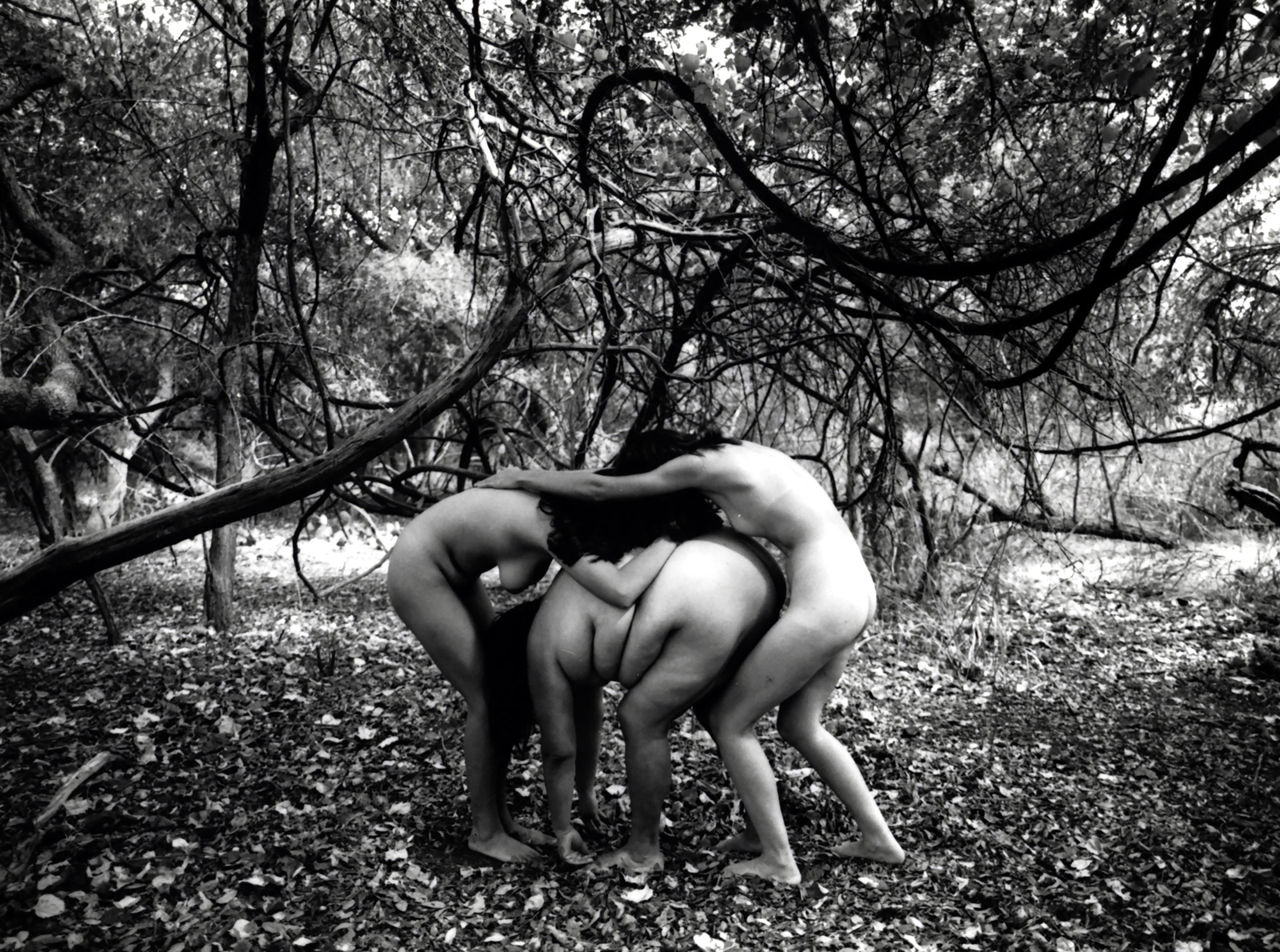
Laura Aguilar, Motion #59, 1999. Gelatin silver print. © Laura Aguilar Trust of 2016.
“It was toward the end of my college career that I was introduced to the work of Laura Aguilar, and it felt like home.”
Navigating the world of fine art photography as a queer, brown, fat, masculine-presenting woman during my undergraduate studies was an isolating journey. Course after course, I searched for some common ground in the works of the great masters of photography, but I never truly saw myself in them, leading to my first creative heartbreak. Personally, it was a time of struggle and growth in which I was coming to terms with my own identity and its influence on my creative pursuits. What I did see in my history of photography books was an extensive archive of Eurocentric, cisgender perspectives and a set of rigid aesthetic ideals, which were then reaffirmed by my own experience.
Laura Aguilar was born in San Gabriel, California, in 1959 to a second-generation Mexican American father and a mother of Irish American, Mexican American, and Californio native descent. Aguilar suffered from auditory dyslexia, which was undiagnosed until her mid-20s, and although this learning disability hindered her ability to communicate with the world, it empowered her to find other forms of expression, ultimately leading to the beginning of her photographic journey.
As a Chicana lesbian who was large-bodied and lived with a learning disability, Aguilar turned the lens on herself to challenge the standards of able-bodied, heteronormative ideals often seen in traditional fine-art depictions of the human form. Her resulting body of work stands as a tender yet powerful testament to her journey of self-acceptance and liberation—a true manifestation of radical softness.
The term ‘radical softness’ was popularized in 2015 by contemporary artist and poet Lora Mathis, but the concept itself emerged from various social and artistic movements, particularly within BIPOC1, feminist, and LGBTQIA2S+2 communities. Radical softness challenges traditional ideas of strength, toughness, and emotional suppression that are often associated with conventional notions of masculinity, instead promoting the idea that vulnerability, empathy, and emotional expression can be powerful forms of resistance and activism. Radical softness encourages individuals to embrace and express their emotions, to reject the pressure to conform to rigid gender roles, and to create spaces where sensitivity, compassion, and kindness are valued.
Offering an honest exploration of body and identity, Aguilar’s work brings to light the often-silenced narratives of marginalized communities and presents a visual ode to Chicanx queer bodies. Aguilar’s radical softness taught me that true liberation lies in embracing the full spectrum of our identities and celebrating the diversity that makes us human. It was her radical softness that empowered me to fall in love, once again, with photography, and with myself.
Although Aguilar continued to endure personal hardships and the indifference of the broader art world toward her work for most of her life, she persisted in defying conventions, eventually turning to the landscape, which remained a source of spiritual sustenance for her until her passing in 2018. In returning to the natural world, she created some of her most notable works, many of which are on view in Laura Aguilar: Nudes in Nature.
As we continue to individually and collectively navigate an evolving world, Laura Aguilar’s legacy remains a guiding light, urging us to embark on our own journeys of self-discovery and radical revolution.