Jun, 02, 2026
Media AlertsCollectionsNew AcquisitionsAmerican and Western American Art
Phoenix Art Museum receives major gift of nearly 200 modern and contemporary Indigenous artworks to deepen its Art of the Americas Collection
New exhibition opening in August 2026 to feature selection of paintings, drawings, photographs, and sculpture gifted from The William P. Healey Collection of Native American Art
PHOENIX (June 2, 2026) – Phoenix Art Museum announces the addition of 185 works by Indigenous artists to its collection. The gift from The William P. Healey Collection of Native American Art marks the single largest gift of Native art to the Museum in its 65+ year history and strengthens the Museum’s Art of the Americas Collection by providing a major infusion of modern and contemporary works by 99 artists representing 44 tribal nations. The acquisition furthers the Museum’s efforts to expand its Art of the Americas holdings and better represent the complex and layered histories of the Americas in its galleries. Drawing from this significant gift, the Museum will premiere The Way We Came: A Century of Indigenous Art from The William P. Healey Collection at Phoenix Art Museum, an examination of modernity in Native American art and the numerous ways Indigenous artists from the 20th century through today have sustained, adapted, and reimagined cultural knowledge. Featuring more than 70 of the gifted works, The Way We Came will be on view from August 26, 2026, through July 11, 2027.
“We are deeply grateful to William Healey for this transformational gift to the Phoenix Art Museum Collection,” said Jeremy Mikolajczak, the Museum’s Sybil Harrington Director and CEO. “These works address a critical gap in our holdings and represent a significant step forward in our commitment to telling a more expansive story of the Americas, one that not only recognizes the profound impact of Native artists in the Southwest, but also honors their enduring influence across North America and their essential role in shaping modern and contemporary art.”
PhxArt’s Art of the Americas Collection spans the 16th century to the present, with strengths in historical art of the American West, pre-modern American art, and Viceregal Latin American Art. With acquired works from the Healey Collection, including paintings, drawings, photographs, and sculptures spanning the 20th century to present, the Museum broadens its holdings to bring in vital perspectives by modern and contemporary Indigenous artists, who explore a wide range of cultural traditions and stories and demonstrate myriad forms of artistic expression. Of note, the collection offers the rare opportunity to highlight the continuity of artistic tradition across generations of families; parent-child artists represented in the gift include Fred and Michael Kabotie, Allan Houser and Bob Haozous,
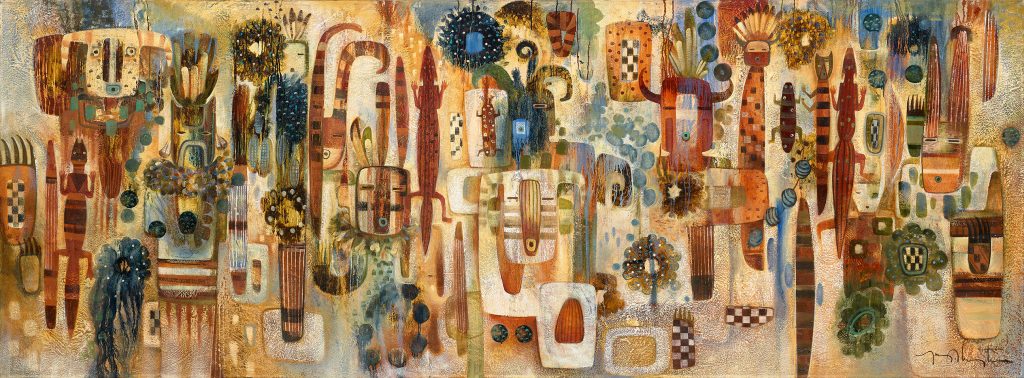
Tony Abeyta, Celebration from the Underworld, 1998-1999. Oil on canvas. William P. Healey Collection of Native American Art at Phoenix Art Museum, Gift of William P. Healey. Photo: Davin Lavikka
and Narciso and Tony Abeyta. Additionally, 22 of the 99 artists represented in the collection are women, advancing deeper recognition of women artists. Placed in conversation with the Museum’s existing Art of the Americas holdings, these works will offer critical counterpoints to established art historical frameworks and enrich dialogues across collecting areas.
Featured artists in the Healey gift to the PhxArt Museum Collection include:
•Jaune-Quick-to-See Smith (Confederated Salish and Kootenai)
•Narciso Abeyta (Navajo)
•Tony Abeyta (Navajo)
•Cara Romero (Chemehuevi)
•Harry Fonseca (Miwok, Nisenan)
•Fritz Scholder (Luiseño)
•Pablita Velarde (Tse Tsan, Santa Clara Pueblo)
•Tonita Peña (Quah Ah, San Ildefonso Pueblo)
•Stephen Mopope (Kiowa)
•Oscar Howe (Dakota Sioux)
•Acee Blue Eagle (Muscogee Creek)
•Allan Houser (Apache)
•Harrison Begay (Navajo)
•Fred Kabotie (Hopi)
•T. C. Cannon (Kiowa, Caddo)
•Kay WalkingStick (Cherokee)
•Emmi Whitehorse (Navajo)
•Michael Chiago (Tho-Hono, Tohono O’odham, Pima-Maricopa)
Stemming from this major acquisition, PhxArt will premiere in August 2026 The Way We Came: A Century of Indigenous Art (The William P. Healey Collection at Phoenix Art Museum), an exhibition that brings more than 100 works from the Healey Collection to Arizona audiences. Curated by Dr. JoAnna Reyes, the Museum’s adjunct curator of Art of the Americas, and second generation Native artist Tony Abeyta (Navajo), with whom Healey shaped this collection, the exhibition will center on the concept of “survivance,” a term coined by Anishinaabe scholar Gerald Vizenor that combines “survival” and “resistance” to describe how Indigenous peoples move beyond mere survival toward an active, creative sense of presence that carries knowledge forward. Exhibition themes include the power of storytelling, the evolution of abstraction and modernism, the role and importance of place and landscape, and the ways cultural knowledge and visual languages have been transmitted through familial lines of artists, artists’ collectives, and art education and training, including the complex legacies of Native boarding schools.
“I am deeply honored to help steward this remarkable collection of Native art and am committed to caring for it with integrity and respect,” said Reyes. “I am especially excited by the opportunity to place these works within a fuller, more connected story of the Americas—one that embraces and highlights the richness, diversity, and continuity of Indigenous artistic traditions across time and place.”
An avid, lifelong collector with a deep interest in Western art and ephemera, William P. Healey developed the Healey Collection over decades in close consultation with Tony Abeyta, a partnership that helped ensure that cultural insight and authenticity guided the acquisition process. Healey prioritized purchasing works directly from artists and their estates and fostered personal relationships with reputable gallerists, including James Trotta-Bono, who served as a close advisor. Healey has demonstrated a sustained commitment to the arts through his philanthropy, including his long tenure as a member of the Charlie Russell Riders and Foundation, his service on the Board of Directors at the C.M. Russell Museum, his prior service as a board member of the Gilcrease Museum in Oklahoma, and his donation of 100 artworks by Indigenous artist to the St. Louis Art Museum in 2024. The Healey gift to PhxArt prioritizes both historical depth and contemporary voices, tracing evolving artistic expressions while honoring tradition.
“The enthusiasm and dedication to excellence I have experienced from the team at Phoenix Art Museum has been extraordinary,” said Healey. “The Museum has deep personal meaning for me over many years, making it especially significant to see the collection find its permanent home here. At a moment when the American art canon is being reshaped and expanded, I believe it is paramount that Native American artists are recognized as essential to that story. Phoenix Art Museum has made a major commitment to using this collection to help achieve that end.”
“I am honored to bear witness to how Bill Healey assembled this important collection,” said Abeyta. “It began with a vision to tell the story from the perspective of Native American artists. Too often, the Western Indigenous narrative has been sidelined or viewed through a romanticized lens. Bill sought to add an authentic testament to this American narrative. The acquisition of this collection by Phoenix Art Museum fulfills that vision by sharing it with the world. The gift of these artworks stands as a testament to his vision to clarify the achievements of Native American artists of the 20th and 21st centuries. Each painting, no matter which tribe or time period, is connected through cultural practice, innovation, and a shared quest for individualism.”
In addition to the exhibition, the Museum will highlight the Healey gift through a future publication slated for Spring 2028, which will be published in partnership with Scala Arts Publishers Inc. Essays will explore themes of resistance and cultural survival from the 1900s–1930s, the history of Native artists moving within the Abstract Expressionist/Modernist movements of the 1930s–1950s, the postwar era and emergent expressions of aesthetic and political self-determination from the 1950s–1980s, and future directions of Indigenous art. Contributors include Dr. Leah Shenandoah (Wolf Clan Member of the Onyo’ta:aká: – Oneida Nation of the Haudenosaunee Confederacy); Dr. Ashley Holland (Cherokee [EBCI]); Dr. Anya Montiel (Tohono O’odham); and Dr. Chelsea Herr (Choctaw).
For images or more information about this latest acquisition and upcoming exhibition, contact the Communications Office of Phoenix Art Museum at samantha.andreacchi@phxart.org or press@phxart.org
About Phoenix Art Museum
Since 1959, Phoenix Art Museum (PhxArt) has engaged millions of visitors with the art of our region and world. Located in Phoenix’s Central Corridor, PhxArt creates spaces of exchange and belonging for all audiences through dynamic exhibitions, collections, and experiences with art. Each year, 300,000 guests on average engage with critically acclaimed national and international exhibitions and the Museum’s collection of more than 21,000 works of American and Western American, Asian, European, Latin American, modern, and contemporary art and fashion design, along with vibrant photography exhibitions made possible through the Museum’s landmark partnership with the Center for Creative Photography at the University of Arizona in Tucson. PhxArt also presents live performances, outstanding examples of global cinema, arts-education programs and workshops, a monthly live-music series, and more for the community. To learn more about Phoenix Art Museum, visit phxart.org or call 602.257.1880.
###